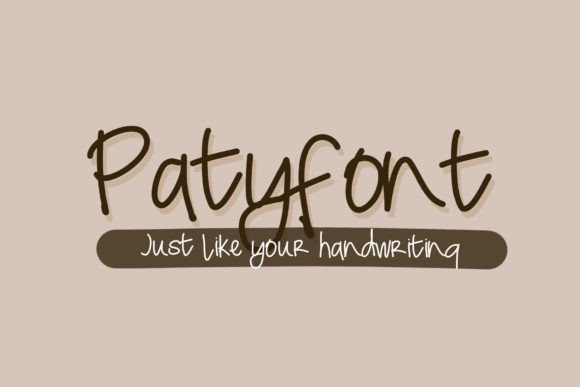
Paty: A Casual Handwriting Font with Practical Versatility
Typography choices often shape how an audience perceives a brand, a publication, or a product. Among the many typefaces available, handwriting fonts occupy a specific niche: they bring human warmth and spontaneity to otherwise structured layouts. Paty is one such font, offering a casual and quick handwriting style that balances legibility with a hand-drawn feel. This article examines what Paty offers, where it excels, and who might benefit most from adding it to their design toolkit.
What Paty Brings to the Table
Paty is a handwriting typeface designed to mimic the natural flow of quick, casual writing. Unlike more formal script fonts that aim for calligraphic precision, Paty embraces an informal character. Its strokes feel unpolished in a deliberate way, as if someone jotted down letters with a pen on paper. This quality makes it particularly useful for projects that require a personal, approachable, or friendly tone.
The font includes a full set of uppercase and lowercase letters, numerals, and basic punctuation, which means it can function as a standalone typeface for short text or as an accent font within a larger design system. Its letterforms are relatively consistent in weight and spacing, a practical advantage over some handwriting fonts that vary too widely and become difficult to read at smaller sizes.
Key Characteristics and Design Strengths
Several features distinguish Paty from other handwriting fonts on the market. First, its stroke contrast is moderate rather than extreme. There is a noticeable difference between thick and thin strokes, but it never becomes dramatic enough to disrupt readability. This balance matters for designers who need a font that works across both digital and print media without requiring extensive adjustments.
Second, the letterforms maintain a relatively upright posture with a slight rightward slant. This gives Paty a natural, forward-moving rhythm that reads easily in longer phrases. The ascenders and descenders are proportional without being exaggerated, which helps the font fit comfortably within standard line heights.
Third, Paty avoids excessive flourishes or decorative swashes. Many handwriting fonts include elaborate tails on letters like "h," "k," or "y," which can look appealing in isolation but create spacing problems in connected text. Paty keeps its terminals simple, making it more predictable when setting multiple words in a row.
From a technical standpoint, the font renders cleanly at various sizes. At 12 to 14 points, it remains readable for body text in informal documents. At larger display sizes, the hand-drawn quality becomes more apparent, and the subtle irregularities in stroke shape add character without feeling sloppy.
Real-World Performance and Practical Value
In practical use, Paty performs well in several common design scenarios. For social media graphics, its casual tone aligns with content that aims to feel conversational rather than corporate. A quote graphic, an announcement, or a promotional post can benefit from the font's approachable appearance. The key is to pair it with a clean sans-serif or serif font for longer secondary text to maintain hierarchy and contrast.
For print materials such as flyers, posters, and signage, Paty holds up well at medium to large sizes. The slightly irregular letterforms create visual interest on posters where a more uniform typeface might feel sterile. However, for very small text on printed materials, such as fine print on a brochure, Paty may not be the best choice. Its handwriting characteristics can cause legibility issues below 10 points, especially on uncoated paper where ink spread softens edges.
In branding contexts, Paty works particularly well for businesses that want to project a handmade, artisanal, or personal image. A bakery, a boutique, a stationery shop, or a creative consultancy might use Paty in their logo or on product packaging. The font's casual nature helps convey that the business values individuality over mass production. That said, brands operating in more conservative industries such as finance, law, or healthcare should consider whether Paty aligns with the trust and formality their audience expects.
Usability and Flexibility Across Projects
One of Paty's more practical strengths is its versatility across different project types. It is not a one-trick font that only works in narrow contexts. Here are some examples where the font demonstrates real usefulness:
- Book covers and editorial design: Paty can serve as a title font for creative nonfiction, memoirs, children's books, or lifestyle magazines. Its handwriting quality pairs well with photography or illustrative covers where a formal typeface would feel out of place.
- Invitations and stationery: Wedding invitations, party announcements, thank-you notes, and save-the-date cards benefit from the personal touch Paty provides. It can be used for the main headline, with a complementary serif font for event details.
- Mugs, bags, and merchandise: Apparel and product printing often call for fonts that feel handcrafted. Paty's consistent stroke weight ensures it prints clearly on fabric and curved surfaces without losing readability.
- Newsletters and email headers: For email campaigns that aim for a warm, direct tone, Paty can be used in the header image or as part of a custom illustration.
- Logos and branding marks: Small businesses and freelancers who want a logo that feels personal rather than corporate may find Paty a strong starting point, especially when paired with a solid icon or emblem.
- Blog headers and web graphics: Bloggers and content creators can use Paty for post titles, section headings, or featured image text to differentiate their visual style from template-driven layouts.
Who Benefits Most from Paty
Given its characteristics and performance profile, Paty is most valuable for certain user groups. Freelance designers and creative professionals will appreciate its reliability for client projects that require a handwritten look without the unpredictability of some alternative fonts. Entrepreneurs and small business owners who handle their own design work can use Paty to achieve a polished but personal brand identity without needing advanced typographic skills.
Marketers and social media managers often need fonts that work quickly in templates and maintain visual consistency across posts. Paty's moderate style makes it a safe choice for recurring content, as it does not demand elaborate pairing rules. Bloggers and publishers focused on lifestyle, food, travel, or personal development can use Paty to create a cohesive aesthetic across their written and visual content.
Educators producing classroom materials, workshop handouts, or instructional guides may find Paty useful for titles and headings where a friendlier tone helps engage learners. The font's legibility at medium sizes means it can also work for short instructional text, provided the audience is not expected to read long paragraphs in a handwriting face.
Practical Recommendations for Use
To get the most out of Paty, consider pairing it with a neutral sans-serif font such as Open Sans, Lato, or Roboto for body text and supplementary information. This combination creates a clear hierarchy: Paty draws attention for headlines, while the clean sans-serif handles reading comfort. Avoid pairing Paty with another handwriting or script font, as the competing styles can create visual confusion.
When using Paty for logos or branding, test it at the sizes your customers will actually see. A logo that looks charming on a screen may appear too informal on a business card or too light on a storefront sign. Adjust spacing manually if needed; some handwriting fonts require extra tracking in uppercase settings to avoid letters feeling cramped.
For print projects, consider the paper stock. Uncoated or textured paper enhances the hand-drawn feel of Paty, while glossy or coated paper can make the same strokes appear sharper. Test a print sample before committing to a large run, especially if small text is involved.
In digital use, Paty performs well on standard screens, but its readability on low-resolution displays or at small sizes should be evaluated. If your audience includes mobile users, set a minimum size of 14 pixels for any text set in Paty to avoid legibility issues.
Limitations to Consider
No typeface is right for every project, and Paty has limitations worth acknowledging. Its casual style means it is inappropriate for formal documents such as contracts, academic papers, official correspondence, or legal notices. Using Paty in these contexts could undermine the seriousness of the content.
The font also lacks the extensive character sets found in professional type families. If your project requires support for multiple languages, special characters, or advanced typographic features such as ligatures and stylistic alternates, verify that Paty covers your needs before committing. Some handwriting fonts offer multiple versions of certain letters to avoid repetition in longer text; Paty does not include this feature, so designers may need to plan layouts that minimize repeated letter patterns.
Finally, because Paty is a single-weight typeface, it cannot provide the range of weights and styles that a full type family offers. You will need to pair it with other fonts to establish visual hierarchy. This is not unusual for handwriting fonts, but it does mean that Paty is best used as a complementary element rather than a complete typographic solution.
Long-Term Value and Considerations
For designers and business owners who frequently produce informal or personal content, Paty offers consistent value over time. Its style is not tied to a specific trend, so it is unlikely to feel dated quickly. The font's readability and moderate design give it staying power for recurring use in branding, packaging, and digital media.
For those who rarely need a handwriting font, Paty may not justify a dedicated purchase if budget is a concern. However, for anyone whose work regularly calls for a casual, human, or approachable typeface, Paty fills that role competently and without the eccentricities that make some handwriting fonts impractical for real projects.
Ultimately, Paty succeeds because it understands its purpose: to provide a quick, casual handwriting style that works in practical design contexts. It does not try to be elegant, ornate, or groundbreaking. Instead, it delivers on its promise of approachable readability, and for many designers and creators, that reliability is exactly what a handwriting font should offer.