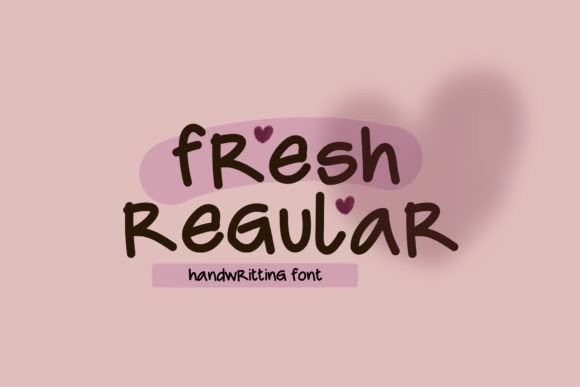
Fresh Regular: Why Imperfect Handwriting Fonts Are Winning Over Perfect Typography
For years, the design world chased perfection. Clean lines, geometric precision, and flawless symmetry dominated everything from branding to web design. But something has shifted. In recent years, designers, content creators, and brands have begun embracing the raw, the human, and the slightly messy. At the heart of this movement is a growing appreciation for handwriting fonts that don't try to be perfect. Fresh Regular stands out in this space precisely because it isn't flawless. It looks like someone sat down with a pen and wrote naturally, without worrying about keeping every letter exactly the same height or slant. That authenticity is exactly what modern audiences are craving.
The Beauty of Imperfection in Digital Typography
When you look at most commercial fonts, there is an underlying uniformity. Each "a" looks identical to the next. Each "g" curves at exactly the same angle. That consistency is impressive, but it can also feel cold. Fresh Regular takes a different approach. This font embraces the natural irregularities that happen when a human hand moves across paper. Some letters lean slightly to the right. Others sit a little higher or lower on the baseline. The stroke thickness varies because that is what real handwriting does. A fountain pen lays down more ink on a downstroke, and less on an upstroke. Fresh Regular captures that organic rhythm.
This irregularity is not a flaw. It is the entire point. When you use a font like Fresh Regular, you are telling your audience that a real person was involved in the process. You are communicating warmth, personality, and a certain level of approachability that no geometric sans-serif can replicate. In a world where AI-generated content and automated design tools are becoming commonplace, anything that feels genuinely human stands out immediately.
What Makes Fresh Regular Different from Other Handwriting Fonts
There are plenty of handwriting fonts available. Some aim for a polished, calligraphic look with perfectly swirled loops and consistent slant. Others try to mimic the neat handwriting of a grade-school teacher. Fresh Regular sits in a different category entirely. It does not pretend to be formal. It does not try to impress with ornate flourishes. Instead, it offers something more valuable: honesty.
The letters in Fresh Regular have a lived-in quality. The spacing between characters varies naturally, as it does when someone writes quickly or pauses to think. Some characters connect to the next letter, while others break off abruptly. This inconsistency mirrors how most adults actually write. Nobody produces perfectly spaced, perfectly uniform handwriting in their daily life. Your shopping list, your journal entries, your sticky notes on the fridge—they all carry the unique signature of your hand. Fresh Regular captures that same unpolished authenticity.
Another distinctive feature is the baseline variation. In most digital fonts, every character sits precisely on a flat, invisible line. In Fresh Regular, letters can float slightly above or dip below that line. This creates a rhythm that feels dynamic and alive. Your eye moves across the text not like it is reading a printed page, but like it is reading a handwritten note from a friend.
How Fresh Regular Fits Into Modern Workflows and Projects
The practical applications for Fresh Regular are broader than you might expect. Many people assume that an imperfect handwriting font belongs only in casual contexts like greeting cards or social media posts. While it certainly excels there, its utility extends far beyond.
In branding, for example, companies are increasingly turning to handwritten typography to differentiate themselves. A tech startup that uses Fresh Regular for their headlines instantly signals that they are human-centered, approachable, and not taking themselves too seriously. A coffee shop that uses it on their menu boards communicates warmth and artisan craftsmanship. A wellness brand that incorporates it into their packaging creates a sense of personal care and attention. The irregular, imperfect quality of the font reinforces the message that perfection is not the goal—connection is.
In content creation, Fresh Regular works beautifully for pull quotes, introductory paragraphs, and section headers in blog posts or articles. It breaks up the monotony of standard body text and draws the reader's attention. Because the font carries emotional weight, readers subconsciously assign more meaning to words set in Fresh Regular. They feel like someone is speaking directly to them, not like they are reading generic copy.
Educational materials also benefit from this style. Worksheets, handouts, and study guides that use Fresh Regular feel less institutional and more approachable. Students often respond better to material that looks like it was written by a teacher rather than printed by a machine. The slight irregularities make the content feel less intimidating and more accessible.
Pairing Fresh Regular with Other Fonts
One of the most common questions designers ask is how to pair an irregular handwriting font with other typefaces. The key is contrast. Fresh Regular works best when it is used sparingly and intentionally. Pair it with a clean, neutral sans-serif for body text. The simplicity of a font like Open Sans, Lato, or Inter provides a stable foundation that allows Fresh Regular to shine as an accent. The contrast between the orderly body text and the handwritten display text creates visual interest without causing chaos.
For more creative projects, you can pair Fresh Regular with a rough, textured serif font. This combination works well for brands that want to emphasize authenticity and craftsmanship. Think of a brewery label, an artisan bakery, or a handmade goods store. The textures and irregularities complement each other and create a cohesive aesthetic that feels organic and curated at the same time.
Avoid pairing Fresh Regular with another handwriting font that has a similar level of irregularity. Too much variation can make the design feel cluttered and hard to read. Use Fresh Regular as the voice of personality, and let a simpler font handle the heavy lifting of readability.
Practical Benefits and Considerations When Using Fresh Regular
Before you download and start using Fresh Regular in every project, there are a few practical considerations to keep in mind. First, legibility. While the font is designed to mimic natural handwriting, that naturalness can sometimes come at the cost of clarity. Make sure to use it at an appropriate size. Small body text set in Fresh Regular can be difficult to read, especially on screens with lower resolution. Stick to using it for headlines, subheadings, short phrases, and accent text where the context helps the reader decipher the letters.
Second, consider your audience. Younger audiences and creative industries tend to embrace irregular handwriting fonts more readily. If your target demographic skews older or more traditional, you might want to use Fresh Regular in smaller doses. A single handwritten headline can add warmth without alienating readers who prefer more conventional typography.
Third, pay attention to the medium. Fresh Regular looks fantastic in print. The texture and variation translate beautifully onto paper. On digital screens, however, some of the subtle irregularities can get lost, especially on small devices. Always test the font at different sizes and on different devices before finalizing your design. What looks charming on a desktop monitor might look sloppy on a phone screen if the spacing or weight doesn't hold up.
Another consideration is the tone of your content. Fresh Regular carries an informal, friendly, and slightly playful energy. It works wonderfully for personal blogs, lifestyle content, children's books, invitations, and brand messaging that emphasizes authenticity. It would feel out of place in a legal document, a financial report, or a formal business proposal. Match the font to the mood you want to create.
Real-World Examples of Fresh Regular in Action
Imagine a small business owner launching a new line of organic skincare products. The packaging features clean white bottles with simple typography—except for the product names, which are set in Fresh Regular. The handwritten quality of the font suggests that each bottle was labeled by hand, reinforcing the handmade, small-batch nature of the products. Customers feel a personal connection before they even read the ingredient list.
Or consider a travel blogger who wants their website to feel like a personal journal. They use a standard serif font for long-form articles but add Fresh Regular for the post titles, date stamps, and pull quotes. The effect is immediate: the site feels like a diary rather than a publication. Visitors stay longer because the experience feels intimate and real.
In the world of event planning, Fresh Regular has become a go-to choice for rustic weddings, outdoor gatherings, and creative workshops. Save-the-date cards, signage, and thank-you notes all benefit from the font's natural, unforced charm. It tells guests that the event will be personal, warm, and full of character.
Why Fresh Regular Resonates in an Age of Digital Uniformity
There is a deeper reason why fonts like Fresh Regular are gaining traction, and it goes beyond aesthetics. We are surrounded by digital uniformity. Every app uses similar interfaces. Every website follows similar layout patterns. Every brand seems to have the same minimalist logo. In that sea of sameness, anything that looks handmade cuts through the noise. Our brains are wired to notice things that deviate from the expected pattern. An irregular handwriting font catches our attention because it looks like something a person made, not something a computer generated.
Furthermore, there is a growing cultural shift toward valuing authenticity over perfection. Social media influencers post unedited photos. Brands show behind-the-scenes footage. People are tired of polished facades and want to see realness. Fresh Regular aligns perfectly with that mindset. It doesn't pretend to be something it is not. It is unapologetically imperfect, and that honesty resonates with people on an emotional level.
Using Fresh Regular is also a statement about your design philosophy. It says that you prioritize human connection over sterile precision. It says that you trust your audience to appreciate warmth over uniformity. In a world where AI can generate flawless typography in seconds, choosing an imperfect, human-like font is a deliberate act of resistance. It is a reminder that the best communication still comes from people, not machines.
What to Look for Before Choosing Fresh Regular for Your Project
If you are considering adding Fresh Regular to your design toolkit, take a moment to evaluate your specific needs. Think about the emotional tone you want to strike. Are you looking for something playful, warm, intimate, or nostalgic? Fresh Regular leans into all of those qualities, but it is particularly strong at conveying immediacy and personal touch. If your project needs to feel like it was written in the moment, this font is an excellent choice.
Also consider the technical aspects. Does the font include the character set you need? Does it support multiple languages? Check the weight and style options. Some handwriting fonts come with multiple weights or alternate glyphs that let you mix and match characters for an even more organic look. Find out what version of Fresh Regular you are getting and whether it offers the flexibility your project requires.
Finally, test it in context. Download the font, set it in a mockup, and look at it for a few days. Sometimes a font that seems charming at first glance becomes tiresome when you have to read it repeatedly. Fresh Regular holds up well because its irregularities are subtle enough that they don't become distracting. But everyone's taste is different. Live with the font before committing to it for a major project.
The rise of fonts like Fresh Regular signals a broader evolution in how we think about typography. We are moving away from the idea that good design must be flawless and toward a more inclusive, human-centered approach. Imperfection has value. Irregularity has beauty. And a font that writes like a real person, with all the quirks and inconsistencies that entails, might just be the most honest tool in your design arsenal.