Carissa Wellington: A Handwritten Script Font for Real Workflows
When you work with type day in and day out, you start to notice patterns. Some fonts are built for speed — clean, neutral, designed to get out of the way. Others demand attention, and that is exactly where Carissa Wellington earns its place. This is not a font you set and forget. It is a deliberately crafted, feminine handwritten script, drawn by hand with a brush pen, and it brings a specific kind of warmth and intention to any project. But knowing what it is only gets you part of the way. The real question is where it fits in your process, how you prepare for it, and how it interacts with everything else you already use.
This article walks through the practical side of working with Carissa Wellington — from understanding its origins and structure to integrating it into real creative and business workflows. Whether you are a designer, a small business owner, a blogger, or someone managing content across multiple platforms, the goal here is to help you use this typeface with clarity and purpose.
What Carissa Wellington Is and Where It Comes From
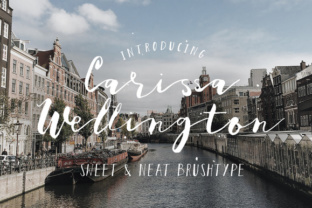
Carissa Wellington is a handwritten script font created with a brush pen. That matters because the tool shapes the result. A brush pen produces natural variation in stroke width, subtle pressure changes, and a sense of rhythm that is hard to replicate with digital-only techniques. Every character in this font was drawn by hand, so the final product retains a human quality — slight inconsistencies, organic curves, and a flow that feels personal rather than mechanical.
The font includes a complete glyph set. That means you get uppercase and lowercase letters, numerals, punctuation, diacritics, and language support for most European-based languages. For someone working across multiple pieces of content or managing multilingual projects, this completeness removes a common friction point. You do not have to worry about missing characters or swapping fonts mid-project because a certain symbol is absent.
Along with Carissa Wellington, you also receive the August font — the typeface used in the preview image. August functions as a companion or accent font, often providing a contrast in weight or style that helps the handwritten script stand out. Having both fonts in one package means you already have a pairing that works. That saves time during the planning phase and reduces the guesswork that can slow down a project.
Where Carissa Wellington Fits in a Project Timeline
Every project follows some kind of arc, even if it is informal. There is a preparation phase, an execution phase, and a refinement phase. Carissa Wellington can serve a different purpose at each stage, depending on how you choose to use it.
Preparation and Planning
Before you start designing or writing, you need to decide on the tone of the piece. Carissa Wellington leans feminine, warm, and approachable. If your project calls for that energy — a product launch for a beauty brand, a personal blog post about creative work, an invitation for a community event — then this font can anchor the visual direction from the start. During preparation, you can sketch layouts, test headlines, and see how the script interacts with your planned color palette. Because the glyph set is complete, you can also prepare multilingual versions of your content without scrambling for character replacements later.
Knowing that August is included as a companion font simplifies one more decision. Instead of searching for a secondary typeface that harmonizes with a handwritten script, you already have one that was designed or selected to work alongside it. This speeds up the planning stage and reduces the number of variables you need to test.
During the Creative Work
When you move into production, Carissa Wellington works well for display text — headings, pull quotes, product names, call-to-action buttons, and any element that needs a human touch. Because it is a script font, it is not ideal for long body copy at small sizes. That is where the August font or another clean sans-serif or serif companion comes in. The contrast between the organic script and a more neutral body font creates visual hierarchy and guides the reader’s eye naturally.
If you are working in software like Adobe Illustrator, Canva, Affinity Designer, or even a web-based platform like WordPress with a custom CSS option, Carissa Wellington behaves predictably as long as you install it correctly. The font files are standard .otf or .ttf formats, so compatibility is broad. Just make sure to check the license terms for the specific use case — commercial projects often require a separate license, while personal use may be more flexible.
Refinement and Quality Control
After the initial design is done, review how the font performs at different sizes and on different backgrounds. Handwritten scripts can become difficult to read if the background is too busy or if the size is too small. Test your layouts on screen and in print if applicable. Check that the letter spacing (kerning) feels natural, especially in words with repeating characters or unusual combinations. Carissa Wellington’s glyph set should handle most cases without manual adjustment, but every project benefits from a quick pass.
Integration with Other Tools, Assets, and Methods
No font exists in isolation. Carissa Wellington interacts with the rest of your toolkit in several practical ways.
- Branding systems: If you already have a brand style guide, test how the script works with your existing logo, colors, and imagery. It can serve as an accent font for social media graphics, email headers, or packaging inserts without overhauling your entire brand identity.
- Content management platforms: Bloggers and publishers can use Carissa Wellington in featured images, quote cards, and title overlays. Some platforms allow direct font uploads; others require you to use image-based text. Plan accordingly.
- Print and merchandise: Because the font includes a complete character set, it works for short print runs — thank-you cards, stickers, labels, or small-batch packaging. Always do a test print to confirm the brush-stroke details render clearly at the intended scale.
- Social media templates: Consistency across posts becomes easier when you have a dedicated script font for headlines. Pair it with August for subtitles or body text, and you have a repeatable template that saves time week after week.
Practical Implementation Tips
Integrating Carissa Wellington into your routine does not require a complete workflow overhaul. A few focused adjustments help you get consistent results without extra effort.
- Install the full family: Make sure both Carissa Wellington and August are installed before you start a project. Having both available in your font menu prevents mid-project switching.
- Set size limits: Use Carissa Wellington at 18pt or larger for readability. Reserve smaller sizes for August or another neutral companion.
- Watch the background: Handwritten scripts can compete with patterned or photographic backgrounds. Place the text on a solid or subtly textured area to maintain legibility.
- Pair with clean fonts: August is provided, but you can also pair Carissa Wellington with standard options like Open Sans, Lato, or Montserrat if you need more flexibility in body text.
- Create presets: If you use design software regularly, save a preset with your preferred sizes, colors, and companion fonts. That way, starting a new project becomes a matter of pulling in the preset instead of rebuilding from scratch.
For a Small Business Owner
You run a boutique shop and need to produce consistent social media content, product tags, and occasional printed materials. Carissa Wellington becomes the headline font for your Instagram posts and the script element on your product packaging. You prepare a Canva template with the font pre-loaded, so every week you swap out the photo and update the text. August handles the smaller details — prices, dates, and secondary information. Over time, this visual consistency builds recognition without requiring you to hire a designer.
For a Blogger or Content Creator
Your blog covers lifestyle topics, and you want the visual identity to feel personal. You use Carissa Wellington in your post title graphics and pull quotes. The body text remains a clean serif for readability. Because the font includes language support, you can write occasional posts in other languages without switching typefaces. The August font appears in your sidebar headings and call-to-action buttons, creating a cohesive look that extends across your site and your social channels.
For a Marketer or Freelancer
You produce assets for multiple clients, each with its own brand voice. Carissa Wellington is one of several tools in your library. When a client’s project calls for a feminine, handcrafted feel, you reach for this font. You keep a folder of approved pairings and test files so you can show options quickly during the proposal phase. The complete glyph set means you do not have to pause a project to find missing characters, and the August companion gives you a ready-made secondary option.
Long-Term Use, Organization, and Consistency
Using a font over months or years requires more than just liking how it looks. You need to keep track of where it is used, how it performs across different media, and whether it still aligns with your goals.
- Document your pairings: Note which companion fonts you have tested with Carissa Wellington and in which contexts they worked well. This saves time when you revisit the font for a new project.
- Check for updates: Occasionally check the font vendor’s site for version updates or expanded glyph sets. An updated version may add language support or fix minor spacing issues.
- Audit your usage: If you use the font across multiple channels, do a quarterly review of how it appears in practice. Are your social graphics still legible? Do your printed materials still feel cohesive? Small adjustments keep the visual identity sharp.
- Respect the license: If you move from personal to commercial use, confirm the license terms. Using fonts correctly protects you legally and supports the work of type designers.
Useful Observations for Getting the Most Out of the Font
Carissa Wellington is not a utility font. It is a stylistic choice, and that strength is also its limitation. It works best when you give it room to breathe — on clean backgrounds, at medium to large sizes, and as part of a layout that lets the brush-pen texture be seen. If you try to use it in dense, information-heavy blocks, the readability drops. But when you use it deliberately, in the right context, it adds a warmth that few neutral fonts can match.
The fact that August is included is not just a bonus; it is a practical advantage. Having a pre-matched companion removes one decision from your process and reduces the risk of pairing a script with a font that clashes in mood or proportion. Use that pairing as a starting point, and only diverge if your specific project demands it.
For long-term use, store the font files in a location you can access easily across devices. If you work on multiple computers, a cloud-based font manager or a synced folder keeps your setup consistent. And when you start a new project, pull in your Carissa Wellington preset or template. The less time you spend on setup, the more time you have for the actual work.
Ultimately, a font like Carissa Wellington is a tool for communication. It brings a human, handcrafted quality to your words — but only if you choose the right moment to use it. By understanding its strengths, planning its placement, and pairing it thoughtfully, you integrate it into your workflow without friction. That is the kind of integration that makes your work look intentional and your process feel smooth.