Valentine Agnes: Evaluating a Handwritten Font Duo for Professional Design Work
Typography choices carry significant weight in visual communication. A well-selected typeface can elevate a brand identity, clarify a message, or add emotional resonance to a layout. Conversely, a poor choice can undermine an otherwise strong design. When evaluating handwritten fonts for professional use, several factors come into play: readability across sizes, character set completeness, stylistic flexibility, and technical accessibility. Valentine Agnes and The Valentine Agnes Font Duo present themselves as options worth examining in this context. This article offers a grounded assessment of what these fonts offer, where they excel, and who might find them most useful.
What Valentine Agnes Is and Why It Deserves Attention
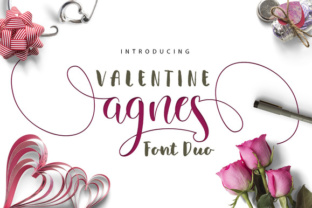
Valentine Agnes is a handwritten typeface designed with a refined, elegant aesthetic. It is not a casual or playful script but one that leans toward sophistication, making it suitable for projects that require a polished yet personal touch. The font includes uppercase and lowercase characters, numerals, punctuation, international glyphs, and PUA (Private Use Area) encoding. PUA encoding is particularly important because it allows users to access extra characters—such as swashes, ligatures, and stylistic alternates—directly within standard applications like Microsoft Word, Adobe Illustrator, or Canva without needing specialized software.
The Valentine Agnes Font Duo expands on this by offering a companion style that remains cohesive with the original while providing additional visual variety. The duo includes uppercase and lowercase characters and numerals, maintaining consistency with the primary font's design language. Together, these two fonts are intended to work in tandem, giving designers more flexibility when composing headlines, titles, quotes, or accent text.
What makes Valentine Agnes worth discussing is not just its aesthetic appeal but its practical utility for professionals who regularly produce content that requires a handwritten look without sacrificing legibility or technical convenience. The inclusion of extra glyphs accessible via PUA encoding means that users can add ornamental flourishes, alternate letterforms, and connected ligatures with relative ease. This reduces the need for manual adjustments or additional graphic elements, streamlining the design process.
Key Characteristics and Design Strengths
The visual character of Valentine Agnes can be described as refined but not rigid. The letterforms have a natural flow, with varying stroke weights that suggest the pressure of a pen moving across paper. The x-height is moderate, which helps maintain readability even at smaller sizes—a point worth noting for body text or captions in presentations, social media graphics, or printed materials. The swashes and swooshes are integrated as alternates or extras, meaning they can be applied selectively rather than forced into every character.
Stylistic alternates allow for variation in letterforms, which is useful when a design calls for a more organic, less repetitive appearance. For instance, multiple versions of the same letter can be swapped in to avoid the mechanical uniformity that sometimes plagues digital handwriting fonts. Ligatures ensure that certain letter combinations connect smoothly, preserving the illusion of natural handwriting.
The Valentine Agnes Font Duo provides a secondary typeface that complements the primary one without competing with it. Depending on the version, the duo may offer a slightly different weight, slant, or level of ornamentation. This creates opportunities for hierarchy within a layout: using one font for headings and the other for subheadings or accents. Designers who work on branding projects, wedding invitations, or editorial layouts often benefit from having two related typefaces that can be mixed without clashing.
From a practical standpoint, the font files are generally well-constructed, with proper kerning and spacing. This reduces the likelihood of awkward gaps or collisions between letters, which is a common issue in less carefully crafted handwritten fonts. The international glyph support also makes Valentine Agnes usable for multilingual projects, extending its reach beyond English-only applications.
Real-World Performance and Practical Value
In real-world use, Valentine Agnes performs reliably across a range of applications. For web designers, the font can be used in image-based assets such as hero banners, social media posts, or email headers. Since it is not a web font intended for body text, it is best deployed in contexts where the handwritten style can be appreciated without straining readability—headlines, quotes, call-to-action buttons, or decorative elements.
For print projects, the font holds up well at display sizes. Business cards, flyers, product packaging, and small signage benefit from the elegant script style. At smaller sizes, such as footnotes or fine print, readability may diminish, but that is typical of most handwritten fonts and not a specific flaw of Valentine Agnes. The presence of numerals and punctuation ensures that practical information—like phone numbers, dates, or prices—can be set consistently in the same typeface.
One area where Valentine Agnes shows clear value is in branding for small businesses, creative professionals, or lifestyle-oriented ventures. A bakery, a boutique, a wedding planner, or a stationery shop might adopt this font as part of its visual identity. The handwritten quality conveys a sense of personal attention and craftsmanship, which can be a differentiator in crowded markets. Paired with a clean sans-serif typeface for body text, Valentine Agnes can anchor a brand's visual voice effectively.
Content creators and social media managers also benefit from having a font that adds visual interest without requiring extensive design skills. A quote graphic, an announcement, or a product highlight can be elevated by the swashes and alternates, making the post feel more curated. The PUA encoding makes it straightforward to access these extras, so users do not need to be expert typographers to achieve professional-looking results.
Quality, Usability, and Consistency
The technical quality of Valentine Agnes is notable. The character set is comprehensive for a handwritten font, covering uppercase and lowercase letters, numerals, punctuation, and international glyphs. The inclusion of ligatures and stylistic alternates adds real utility, especially for users who produce long-form content or repeated designs where variation matters.
Usability is enhanced by the PUA encoding, which maps extra characters to specific keystrokes. Many applications allow users to insert these characters via a glyph panel or character map. This removes the barrier that often exists with fonts that require advanced software to access alternates. For professionals who work across different tools—switching between Adobe Creative Cloud, Affinity products, or even web-based platforms—this compatibility is a practical advantage.
Consistency across the two fonts in the duo is generally good. The design DNA carries through, so mixing them does not result in a jarring mismatch. However, users should test both fonts together in their specific context to ensure that the relationship between weights or styles works for their intended hierarchy. As with any font pair, what works in one layout may not work in another, and some experimentation is advisable.
Reliability in file formats is also worth noting. Fonts delivered in OTF or TTF formats with proper encoding will install cleanly on both macOS and Windows systems. No unusual corruption or rendering issues have been commonly reported, which speaks to the font's production quality.
Who Benefits Most and in What Situations
Professional designers and art directors will find Valentine Agnes useful for projects that require a handwritten element with a sophisticated edge. Wedding invitations, greeting cards, branding for luxury or artisanal products, and editorial layouts are natural fits. The font duo gives these users the ability to create typographic contrast without introducing a second unrelated typeface, which simplifies the design process and ensures cohesion.
Small business owners and entrepreneurs who handle their own marketing materials will appreciate the ease of use. A font that includes swashes and alternates accessible through standard software reduces the need to outsource design work for every small asset. For a boutique owner creating a promotional flyer or a blogger designing a new header, Valentine Agnes offers a way to achieve a polished look independently.
Freelancers and content creators who produce visual content regularly—such as social media posts, YouTube thumbnails, or email newsletters—can leverage the font to add a distinctive visual signature. The duo allows for variation within a consistent style, which helps maintain brand recognition while keeping content fresh.
Educators and publishers working on materials that benefit from a personal, approachable tone may also find value. Worksheets, certificates, or classroom posters can be made more engaging without sacrificing legibility. The international glyph support is particularly useful for multilingual educational content.
Limitations and Considerations
No font is universally appropriate, and Valentine Agnes has limitations worth acknowledging. The handwritten style, while elegant, may not suit all industries or audiences. Corporate legal documents, technical manuals, or highly formal communications would likely require a more neutral typeface. The decorative nature of the swashes and alternates, if overused, can become distracting rather than enhancing.
Readability at very small sizes is a concern, as with most script fonts. Users should plan to deploy Valentine Agnes at display sizes—typically 14 points or larger—for the best results. In body text contexts, a simpler companion font is advisable.
The duo may also have a learning curve for users unfamiliar with PUA encoding or glyph panels. While the process is not difficult, it requires a small investment of time to understand how to access alternates and swashes. Documentation or a cheat sheet from the font's creator would be helpful, but not all providers include detailed instructions.
Additionally, the font's aesthetic may be seen as feminine or delicate, which could be a consideration depending on the brand or audience being targeted. Designers should evaluate whether the style aligns with their client's or organization's identity before committing.
Practical Recommendations for Prospective Users
If you are considering Valentine Agnes for a project, start by testing it at the sizes and media you plan to use. Generate a few sample layouts that include headlines, subheadings, and any text that requires numerals or punctuation. Evaluate how the font performs in both the primary and duo versions. Look for consistency in stroke weight, letter spacing, and overall rhythm.
For branding projects, pair Valentine Agnes with a clean sans-serif or neutral serif for body text to create contrast. This combination allows the handwritten font to serve as an accent or headline style while maintaining readability for longer passages. Avoid pairing it with another decorative or script font, as this can create visual clutter.
Take advantage of the stylistic alternates and ligatures, but use them with restraint. A single well-placed swash can draw attention effectively; too many can undermine the design's clarity. The goal is to enhance communication, not to obscure it.
For those working across multiple platforms, confirm that your software supports PUA encoding. Most modern design and word processing applications do, but older versions may require updates. Testing early in the workflow will prevent surprises during production.
Finally, consider the long-term value. A font that is versatile, technically sound, and visually distinctive can become a reliable tool in your design library. Valentine Agnes, particularly as a duo, offers enough range to be useful across a variety of projects over time. It earns its place alongside the other thoughtfully crafted resources a professional designer or content creator would want in their toolkit.
Ultimately, Valentine Agnes delivers on its promise of elegance and practical usability. It is not a one-size-fits-all solution, but for the right audience and application, it proves to be a well-executed asset that balances beauty with function. Approached with an understanding of its strengths and limitations, it can help produce work that looks intentional, refined, and human.