Pepper Lemon: A Font Duo That Brings Character to Real Projects
You know that moment when you're staring at a blank canvas—or a half-finished flyer, a product label, or a social media post—and everything feels a little too clean, a little too generic? The text sits there, perfectly aligned, perfectly dull. That's where a font duo like Pepper Lemon steps in. Not as a gimmick, but as a practical tool that gives your project a genuine handcrafted feel without requiring you to actually hand-letter anything yourself.
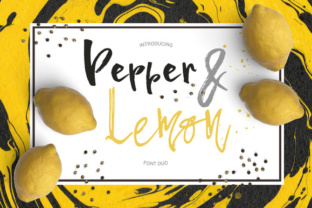
Pepper and Lemon are two fonts designed to work together, but each brings something distinct. Pepper is a texturized brush font—think bold strokes, uneven edges, and the kind of grit that makes a word look like it was painted onto a rough surface. Lemon, by contrast, is a marker font. It has that felt-tip look, the slight irregularities that come from a real hand moving across paper. Together, they give you range. You get the weight of Pepper for headlines or emphasis and the lighter, more playful touch of Lemon for supporting text or accents.
Where Pepper Lemon Fits Into Everyday Work
Let's talk about where these fonts actually show up in the real world. Because a font duo is only useful if it solves a problem you already have. If you're a small business owner labeling homemade candles, you need something that says "handcrafted" without looking like a clipart disaster. Pepper gives you that gritty authenticity on the jar. Lemon can handle the scent name or care instructions on the back. The contrast between the two does the work for you.
If you're a blogger or content creator, you've probably cycled through dozens of font pairs trying to find one that doesn't make your Instagram stories look like a corporate memo. Pepper is great for a bold quote overlay—it catches the eye because the texture makes it feel tactile. Lemon works for the smaller caption beneath it. The combination feels intentional, not random.
Educators and workshop facilitators also find a natural home here. Classroom posters, worksheet headers, or bulletin board titles benefit from a font that looks like it was made by hand. Pepper's brush texture can anchor a subject title, while Lemon keeps subheadings readable but still casual. Students respond to that visual hierarchy differently than they do to standard sans-serif fonts. It signals that the material was made with care.
Creative Projects That Benefit from Texture and Contrast
Not every project needs a font duo. But the ones that do tend to involve storytelling, branding, or any situation where you want the text to feel like part of the design rather than an afterthought.
Consider a poster for a local event—a farmers market, a community art show, a small music gig. You could use a clean digital font and it would be fine. But if you use Pepper for the event name and Lemon for the date, time, and location, the poster suddenly feels like something someone actually made. It suggests personality. It suggests that the event itself might be worth showing up to. That's not hype—it's a real psychological shift in how people perceive what they're looking at.
Merchandise design is another sweet spot. T-shirts, tote bags, mugs—anything that gets printed on a physical object benefits from fonts that look like they came from a real brush or marker. Pepper's texture holds up well on fabric prints because the irregularities make it look more like a screen-printed design. Lemon can handle smaller text like a location or a tagline. The two work together to create a cohesive but visually interesting layout.
For freelance designers and illustrators, having a duo like this in your toolkit saves time. Instead of hunting for complementary fonts across different families, you have a pair that was built to match. That doesn't mean you can't use them separately—Lemon works wonderfully on its own for sketch-style notes or informal branding—but when you need a quick, reliable pair, Pepper Lemon removes the guesswork.
Digital Content and Social Media Use
Scroll through any social platform and you'll see the same polished, overused fonts everywhere. Breaking away from that doesn't require a massive rebrand. It often just means choosing better typography.
Pepper Lemon works especially well for digital content that aims to feel personal. Think about a small business posting a new product announcement on Instagram. A photo of the product with a Pepper headline overlay reads as more authentic than the same photo with a standard bold font. The texture suggests process, craftsmanship, and care. Lemon can handle the product description in the caption or as a secondary graphic element.
For YouTube thumbnail creators, the stakes are higher. Thumbnails need to grab attention in a split second while still being readable. Pepper's bold, texturized strokes stand out even at small sizes. A thumbnail title like "DIY Project" or "New Launch" set in Pepper gives the video a tangible feel before anyone even clicks play. Lemon can add a subtle subtitle or a call-to-action without competing for attention.
Even something as simple as an email newsletter header benefits from this duo. Instead of relying on standard web-safe fonts, embedding a Pepper header graphic adds personality right at the top. It sets a tone that says the content inside won't be generic either.
Professional and Commercial Applications Worth Considering
It's easy to assume that textured, hand-drawn fonts belong only in casual or creative settings. But that's not the full picture. Plenty of professional use cases benefit from a carefully applied brush or marker aesthetic, especially when the goal is to communicate approachability or authenticity.
A restaurant menu, for example. If you run a café or a food truck, your menu is one of the first things customers touch. Using Pepper for the section headers—"Coffee," "Pastries," "Specials"—gives the menu a chalkboard feel even if it's printed on standard paper. Lemon can list the individual items and prices. The result is warm and readable, not cold and corporate.
A real estate agent's open house flyer might seem like an unlikely place for a textured font, but think about it: buyers are looking for a home, not a transaction. A flyer header set in Pepper—something like "Welcome Home" or "Charming Bungalow"—feels more inviting than the same phrase set in Arial. Lemon handles the property details. The contrast works because it signals both personality and professionalism.
For product packaging, particularly for small-batch goods like jam, soap, or coffee, Pepper Lemon gives you a branded look without needing a full design team. You can print your own labels at home or through a small printer and still achieve something that looks intentional. Pepper takes the product name. Lemon takes the ingredients or weight. The duo becomes your branding identity.
What to Consider Before Using Pepper Lemon
No font duo is perfect for every situation. Knowing where and when to use Pepper Lemon means understanding its limitations as well as its strengths.
Legibility is the first thing to check. Pepper's textured brush strokes make it visually engaging, but it's not ideal for long blocks of text. Save it for headlines, titles, or short phrases. Lemon is more readable at smaller sizes, but it still carries that marker feel, which means it works best in moderate quantities. A paragraph set entirely in Lemon may tire the eyes over time. The solution is to use Pepper for impact and Lemon for short supporting text—exactly what the duo was designed for.
Consider your audience and context. A financial services newsletter probably isn't the right place for a brush font. But a children's book publisher, a craft brand, or a lifestyle blog? That's where this duo shines. Match the font to the tone you want to project, not the other way around.
Also think about the medium. On screen, Pepper's texture holds up well at typical display sizes. For print, pay attention to resolution and paper quality. Heavily textured fonts can lose detail on very coarse paper or at very small print sizes. Doing a quick test print before committing to large quantities is always smart.
Pairing Pepper and Lemon with neutral fonts is another option worth exploring. If you need a body font for longer text, consider pairing the duo with a clean sans-serif like Open Sans or Lato. That way, Pepper handles the headline, Lemon handles the accent or subtitle, and the sans-serif carries the bulk of the reading. The result is a layered, professional design that still feels handcrafted at the top.
Real Outcomes, Not Just Aesthetics
At the end of the day, using Pepper Lemon isn't about making something look "cool" or "trendy." It's about solving a communication problem. You want your project to stand out, to feel personal, to signal that a human being made it. These fonts do that because they don't try to hide their imperfections. The brush strokes are uneven. The marker lines vary in pressure. That's the point.
Whether you're a freelancer designing a client's brand identity, a teacher creating classroom materials, a small business owner labeling products, or a hobbyist working on a passion project, Pepper Lemon gives you a reliable way to add character without adding complexity. You don't need to learn hand lettering. You don't need to spend hours searching for the perfect pairing. You just need to know when to use bold texture and when to let a marker line carry the message.
And that's the real value of a font duo built with intention. It lets you focus on the content, the audience, and the purpose of your project—while the typography quietly does the work of making it feel real.