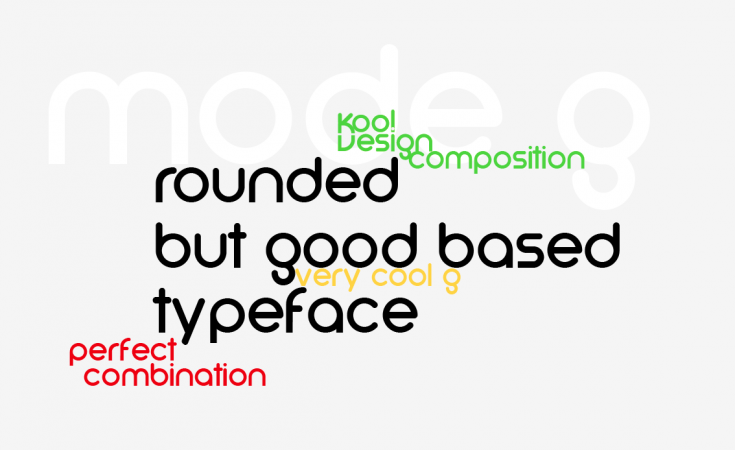
ModeG: The Sans Serif Font That Bridges Geometric Precision and Intentional Branding
Every typeface carries a disposition. Some fonts feel conversational, almost handwritten, inviting the reader into a casual exchange. Others project authority through sharp serifs and rigid structure. But there is a smaller category—one that appeals to those who see design as a form of logic. ModeG sits squarely in that territory. It is a geometric sans serif font, built with mathematical clarity, that speaks directly to anyone who believes a logo should feel composed, not accidental.
If you have ever spent hours adjusting the kerning between two letters, or felt a sense of satisfaction when a circular logo element aligns perfectly with the arc of a letterform, you already understand the mindset ModeG serves. This typeface was not designed to fade into the background. It was built for people who love geometry and who want their visual identity to feel deliberate, almost architectural.
What ModeG Is and Why It Matters for Strategic Work
ModeG is a sans serif typeface rooted in geometric forms. Its letter shapes are built from circles, straight lines, and consistent angles. The result is a font that feels both modern and controlled. Unlike humanist sans serifs that mimic the natural variation of handwriting, or grotesque sans serifs that evolved from nineteenth-century commercial printing, ModeG leans into abstraction. It presents letters as pure shapes.
For professionals who work with branding, logos, or any visual communication, this distinction matters. A font that embraces geometry removes ambiguity. It tells the viewer that the organization behind it values precision. It signals that decisions were made intentionally, not left to chance. When you choose ModeG, you are not just picking a typeface. You are making a statement about how you approach your work.
This is especially relevant for entrepreneurs and small business owners who need to establish credibility quickly. A startup without a track record can borrow authority through disciplined design. ModeG helps create that impression. Its composed letterforms suggest that the company thinks before it acts, that it has a plan, and that it executes with care.
Aligning Typeface Choice with Long-Term Goals
Every branding decision should trace back to a goal. That might sound obvious, but many professionals choose fonts based on personal preference or fleeting trends rather than strategic fit. ModeG rewards the opposite approach. Because it is so visually distinct, it works best when you have a clear sense of what you want to communicate and to whom.
Consider a firm that offers analytical services—data consulting, financial modeling, logistics optimization. That organization benefits from a typeface that feels precise. ModeG reinforces the message that the firm deals in measurable outcomes. For a creative studio that builds generative art or computational design, the same font signals alignment with mathematical creativity. The goal determines whether ModeG supports or distracts from the message.
When planning a brand identity, start by writing down three words that describe how you want your audience to feel. If those words include terms like structured, confident, clean, or architectural, ModeG becomes a strong candidate. If the list includes warm, organic, or whimsical, you may want to consider a different family or use ModeG selectively as an accent.
Using ModeG in Logo Design Without Losing Humanity
One of the common concerns about geometric fonts is that they can feel cold or impersonal. This is a valid risk, especially for businesses that rely on personal relationships. A financial advisor, for example, needs to convey both competence and trust. A purely geometric logotype might tip too far toward sterility.
The solution is not to abandon ModeG, but to use it with intention. Pair it with a secondary typeface that brings warmth. Use a rounded version of the font if one is available. Or let geometry dominate the logo while softer elements—photography, color palette, illustration—balance the overall impression. ModeG does not need to carry the entire emotional load. It can serve as the anchor while other design choices provide the human touch.
For a logo that is meant to feel maniacally composed—a design where every pixel has been placed with purpose—ModeG is almost ideal. The font itself becomes part of the composition. A monogram, a wordmark, or a combination mark built around ModeG will look like it was engineered, not sketched. That is a powerful positioning tool for industries where precision is a selling point.
Practical Applications Across Disciplines
ModeG is not limited to logos. Its utility extends across a range of use cases where clarity and structure matter. Here are several scenarios where the font supports better outcomes:
- Editorial design and data visualization: Charts, infographics, and data-heavy layouts benefit from a typeface that does not introduce visual noise. ModeG keeps the focus on the numbers and the narrative.
- Product packaging: For brands that sell minimalist or functional products, ModeG reinforces the message that the contents are well considered.
- Digital interfaces: UI labels, navigation menus, and microcopy set in ModeG can create a sense of consistency across screens, especially when paired with systematic spacing and alignment.
- Presentation decks: A pitch deck built with ModeG signals that the team behind it values clarity. Investors and partners read visual cues as carefully as they read financial projections.
Each of these applications shares a common thread: the font serves a function beyond decoration. It supports comprehension, reinforces positioning, or builds trust through visual discipline.
Planning Your Approach to ModeG
Before committing to ModeG across all materials, invest time in testing. Load the font into your design environment and build a few mockups. Test it at small sizes to confirm legibility, especially on screens. Some geometric fonts lose distinction in body text because the letterforms become too similar. ModeG tends to perform well in display sizes and medium-length text blocks, but always verify with your actual content.
Consider also the audience. A younger demographic accustomed to modern digital products will read ModeG as current and intentional. An older or more traditional audience might perceive it as stark or unfamiliar. Context matters. A tech startup targeting early adopters will face different reactions than a law firm updating its identity. Know your viewers before you finalize.
If you are working with a team, involve them in the evaluation. Ask for reactions without revealing the font name first. Show them a logo set in ModeG and one set in a humanist sans serif. Listen to the words they use. If they describe the ModeG version as “clean,” “professional,” or “structured,” you are on track. If they say it feels “cold,” “rigid,” or “unfriendly,” adjust your pairing strategy or reconsider the fit.
Risks of Using ModeG Without Clear Objectives
The most significant risk of adopting ModeG is misalignment. A font this specific carries strong connotations. Applying it to a brand that is trying to feel approachable, rustic, or handcrafted creates cognitive dissonance. The audience senses the inconsistency even if they cannot name it. That dissonance erodes trust.
Another risk is overuse. When every element of a brand is set in the same geometric typeface, the result can feel monotonous. Visual hierarchy depends on contrast. ModeG works best when it is allowed to lead, not when it is forced to do everything. Reserve it for headlines, logos, and key identifiers. Use a complementary typeface for long-form body copy, captions, and secondary information.
There is also the risk of trend following. Geometric sans serifs have cycles of popularity. If you choose ModeG simply because it looks current, you may find yourself rebranding again in a few years when tastes shift. Instead, anchor the decision in your brand strategy. If the geometry of ModeG supports a message that will still be true five years from now, the font choice will outlast any trend.
Long-Term Value and Adaptability
Brands that endure are rarely built on impulsive decisions. ModeG, when chosen thoughtfully, becomes a foundation that scales. A startup can use it for a single landing page and later extend it to an entire product ecosystem without losing coherence. A creator can use it to unify a YouTube channel, a newsletter, and a merchandise line. A consultancy can apply it to proposals, reports, and signage, knowing the visual thread remains consistent.
The long-term value lies in recognition. Over time, audiences begin to associate the geometric precision of ModeG with the quality of the work behind it. That association does not happen quickly. It requires repeated, consistent exposure. But when it does take hold, it becomes a competitive advantage. The font ceases to be a design choice and becomes part of the brand’s identity in the minds of its audience.
Making the Decision Intentionally
If you are considering ModeG, take a step back before you download it. Ask yourself what specific outcome you want this typeface to help you achieve. Is it clearer communication? A stronger first impression? Better recognition in a crowded market? Write that outcome down. Then evaluate every use of the font against that standard.
Use ModeG when you need to emphasize structure. Use it when you want your audience to feel that your work is composed, not improvised. Use it when geometry is not just a stylistic preference but a reflection of how you think. If those conditions are met, the font will serve you well.
And if you are still unsure, test it in a low-stakes context first. Build a single-page site, a presentation cover, or a business card. See how it feels in practice. The best decisions come from experimentation, not theory. ModeG rewards those who take the time to understand its strengths and limitations.
Geometry as a Strategic Asset
In the end, choosing ModeG is not about loving geometry for its own sake. It is about recognizing that form communicates function. A carefully constructed logo or layout signals that the work behind it is equally careful. For entrepreneurs, marketers, and creators who operate in competitive spaces, that signal can make the difference between being overlooked and being remembered.
ModeG offers a path to that kind of communication. It is a tool, not a solution by itself. But when used with clear goals, thoughtful pairing, and consistent application, it becomes part of a strategy that supports long-term results. That is the real value of a typeface built for people who love geometry and maniacally composed logos. It gives you a way to show, not just tell, that you mean what you do.