Dreams Liem: A Script Font for High-Impact Headlines in Digital and Print Design
When selecting a typeface for a project, the choice often comes down to balancing personality with readability. Among the many script fonts available, Dreams Liem has gained attention as a high-impact option designed specifically for headlines. This font combines the flowing elegance of a script with a bold presence that works across both digital and print media. For designers, marketers, and content creators evaluating their next font selection, understanding what Dreams Liem offers—and where its limitations lie—can help determine whether it is the right tool for a given project.
What Makes Dreams Liem Distinctive?
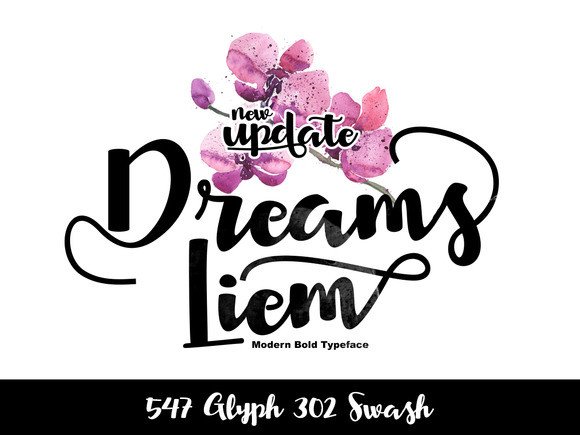
Dreams Liem is a script typeface that emphasizes visual impact through sweeping strokes, pronounced contrasts between thick and thin lines, and a polished, contemporary feel. Unlike many script fonts that aim for a hand-drawn or casual appearance, Dreams Liem leans toward a more refined and structured aesthetic. Its letterforms are carefully constructed to maintain legibility even when scaled up, a feature that makes it particularly suited for headline use.
The font’s character set includes uppercase and lowercase letters, numerals, and standard punctuation, though it does not typically include extensive multilingual support or advanced OpenType features such as stylistic alternates or swashes. This simplicity means that what you see is largely what you get—a clean, high-impact script that does not rely on decorative flourishes to make its statement. The design prioritizes clarity and presence, which is a notable distinction from ornate script faces that can become busy at larger sizes.
Why Consider Dreams Liem for Your Projects?
One of the primary reasons designers turn to Dreams Liem is its ability to command attention without sacrificing readability. Headlines are the first element most viewers notice, and a font that balances flair with clarity can set the tone for the entire piece. Dreams Liem achieves this by using consistent stroke weights and open counters that prevent letters from closing up at display sizes. This makes it a practical choice for titles, banners, and hero text in web design, as well as for posters, flyers, and packaging in print.
Another benefit is its versatility across media. Because the font holds up well on screens—where fine details can sometimes blur or pixelate—it can be used confidently in digital ads, social media graphics, and website headers. At the same time, its sharp edges and clear contours translate effectively to print, where ink spread and paper texture might soften more delicate scripts. For branding projects that require a consistent look across online and offline channels, Dreams Liem offers a unified solution.
Additionally, the font’s impact comes from its design rather than from excessive ornamentation. This makes it easier to pair with other typefaces, such as clean sans-serifs for body text or geometric fonts for supporting elements. A designer who wants a headline font that stands out but does not clash with secondary text may find Dreams Liem a reliable choice.
Tradeoffs and Considerations
No font is without tradeoffs, and Dreams Liem is no exception. Because it is a script face, it is inherently less legible at small sizes than simple sans-serif or serif types. Using it for body text, captions, or any lengthy passage is likely to cause strain for readers. Even at medium sizes, the flowing nature of the script can reduce speed and comprehension, especially for users with visual impairments or reading difficulties.
Another limitation is the font’s stylistic specificity. Dreams Liem has a distinct personality that evokes elegance, creativity, and forward-thinking design. While this is an asset in many contexts, it may not align with brands that require a conservative, traditional, or highly corporate image. For legal documents, financial reports, or academic publications, a more neutral typeface would be more appropriate.
Licensing is another factor to weigh. Depending on where Dreams Liem is obtained, the license may restrict use to a certain number of projects, users, or domains. Commercial use often requires a paid license, and some versions may limit embedding in mobile apps or web font use. It is important to verify the specific licensing terms before committing to a purchase or download.
File format and compatibility can also affect workflow. Some versions of Dreams Liem are provided only as OTF or TTF files, without web font formats like WOFF or WOFF2. This may require conversion for web use, which can sometimes degrade quality or alter metrics. Designers planning to use the font across multiple digital platforms should confirm that the format they need is available.
Finally, pairing Dreams Liem with other typefaces requires some thought. Because the font has a strong visual weight, it can overwhelm lighter or thinner companion fonts. Successful pairings often involve a sans-serif with moderate contrast, such as a neutral grotesque or a humanist sans, to balance the script’s dynamism. Testing combinations early in the design process can save time and avoid mismatches later.
Where Dreams Liem Excels
Dreams Liem is a strong fit in scenarios where the text is short, prominent, and meant to convey energy or sophistication. Common applications include:
- Headlines for landing pages or splash screens
- Logos and brandmarks for creative agencies, boutiques, or lifestyle brands
- Posters for events, conferences, or product launches
- Social media graphics where the font needs to stand out in small thumbnails
- Packaging for premium or artisanal products
- Digital advertisements, particularly those displayed at large sizes on desktop
- Titles for video content, such as YouTube intros or presentation slides
In each of these contexts, the font’s high impact is a direct benefit. It reduces the need for additional graphic elements, letting the typography itself carry the message. For designers who want to minimize visual clutter while still making a statement, Dreams Liem can serve as a primary visual anchor.
When Alternatives May Be Worth Considering
There are also situations where a different typeface might serve the project better. If the text needs to be read at small sizes—such as in footnotes, image captions, or form labels—a clear sans-serif or a well-crafted serif would improve accessibility and user experience. Similarly, if the design calls for a neutral tone or a highly formal feel, a script font may not be the right choice, regardless of how well it is executed.
For projects that require extensive multilingual support—such as websites serving international audiences—Dreams Liem may lack the necessary glyphs for languages with diacritics or non-Latin scripts. In that case, a more comprehensive typeface family would be a better investment.
Another consideration is scalability. While Dreams Liem performs well at headline sizes, its performance at very large or very small extremes is less tested. If the design demands a font that can be used from billboard sizes down to mobile interface elements without breaking, a variable font or a well-crafted sans-serif with multiple weights might offer more flexibility.
Finally, if the brand identity relies on a unique or custom look, a commercially available script font like Dreams Liem may not provide enough differentiation. Custom lettering or a less commonly used typeface could better serve that need.
Practical Decision-Making Insights
To determine whether Dreams Liem aligns with your goals, start by evaluating the context of use. Write down the specific applications—headlines only, or also subheadings and body text? If the font will only be used for display text, Dreams Liem is a viable candidate. If it needs to cover multiple roles, look for a typeface family with more weights and widths.
Test the font in its intended environment. Download a trial version or use a font testing tool to see how it renders on screens at various resolutions, and how it prints on paper or other materials. Pay attention to how it pairs with the other fonts in your design system. Mock up a few layouts and review them on different devices to catch any legibility issues early.
Consider the audience. If your readers are likely to view the content on small screens or in low-light conditions, a script font may reduce engagement regardless of its aesthetic appeal. Accessibility guidelines recommend a minimum x-height and sufficient letter spacing for body text, but for headlines, the priority should still be recognizable letterforms. Dreams Liem performs well in this regard, but it is always wise to test with real users if possible.
Budget and licensing should also factor into your decision. If the font requires a paid license and your project has a limited budget, compare it with free or open-source alternatives that offer similar impact. Some scripts with comparable visual weight are available under permissive licenses, though they may lack the polish or consistency of Dreams Liem.
Finally, think about the long-term use of the font. If you are selecting a typeface for a brand that will be used for years, consider whether Dreams Liem will remain relevant as design trends evolve. Script fonts often have a strong period association, and a very distinctive style can date a brand more quickly than a neutral one. However, the clean lines of Dreams Liem make it less trend-dependent than more ornate scripts, so it may age better than expected.
Aligning Dreams Liem with Your Needs
Dreams Liem offers a compelling option for designers who need a high-impact script font that works across digital and print environments. Its balanced design, clear letterforms, and versatility make it a practical choice for headlines, logos, and other prominent text elements. However, its limitations—reduced legibility at small sizes, stylistic specificity, and potential licensing constraints—means it is not a universal solution.
By evaluating your project’s specific requirements, testing the font in real conditions, and considering both the benefits and tradeoffs, you can make an informed decision about whether Dreams Liem is the right tool for your work. When used appropriately, it can enhance a design without overwhelming it, providing the visual impact you need while maintaining the readability your audience deserves.